
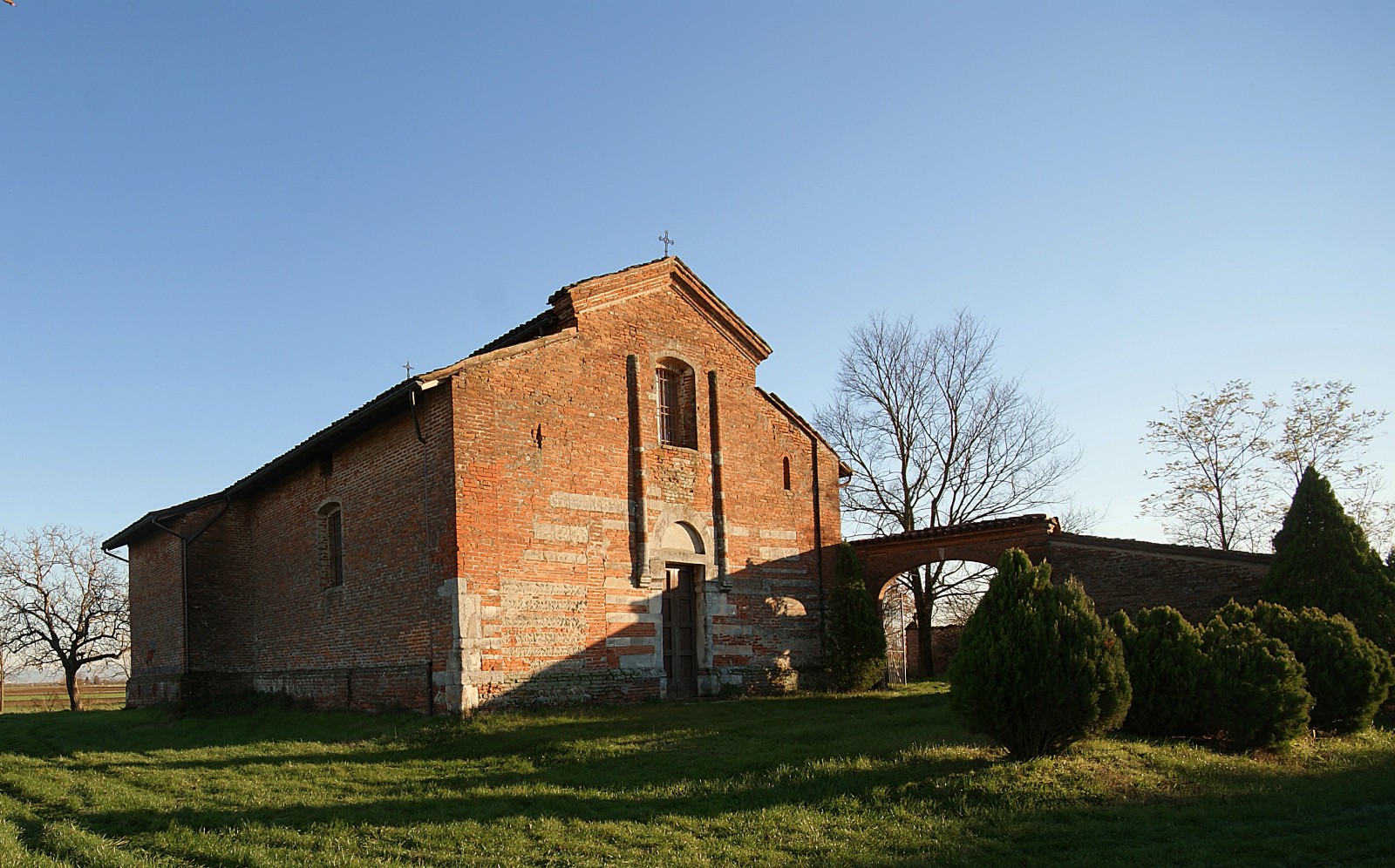


Chiesa SS. Trinità da Lungi
Built by the Canons Regular of Santa Croce di Mortara, perhaps around 1130, this church was first mentioned in 1134. The suffix "da fari" (far away) was added in the 19th century to distinguish it from the oratory in the village, also dedicated to the Holy Trinity. Probably built within a monastic complex, of which abundant traces were visible in the 19th century, the church has undergone countless changes over the centuries. In the 16th century, it was used as a haystack and barrel storage facility. Significant—and probably decisive for the preservation of what remains of the ancient structure—was the Ghilini intervention in 1731, which significantly modified the interior by introducing vaulted ceilings, requiring the entire building to be raised. The church's floor plan was also modified with the construction of the "hermit's" dwelling. In 1836, after further significant work, perhaps involving the reconstruction of the vaults and the painting of the walls, the church was reopened for worship. Other significant interventions were carried out between the late 19th century and the 1920s by the owners, who freed the hidden single-lancet window from the outside and scraped the plaster inside. The current state stems from the restorations of the 1930s by architect Vittorio Mesturino of the Superintendency of Fine Arts of Turin. In line with the restoration concept of those years, the state of the church was modified in an attempt to return the building to a previous state, closer to "historical reality." While freeing the apse from the internal walls that hid the single-lancet windows has restored—in a certain sense—a shred of Gamondio, the works to reconstruct the façade are not based on any historical certainty; Mesturino even suggested a complete renovation of the building, which fortunately never materialized. Of the original Romanesque-style construction, a large part of the apse, the outline of some walls and the refined Byzantine-style capitals remain today.
Information and contacts
strada Trinità da Lungi - 15073 Castellazzo Bormida (AL)
Telephone: +39 (0131) 272.832
E-mail: biblioteca@comunecastellazzobormida.it
Link
https://www.cittaecattedrali.it/it/bces/150-chiesa-della-santissima-trinita-da-lungi
https://www.comune.castellazzobormida.al.it/it-it/vivere-il-comune/cosa-vedere/chiesa-della-trinita-da-lungi-5803-1-3feb96506195f23ec041cbb8e6e269d9


