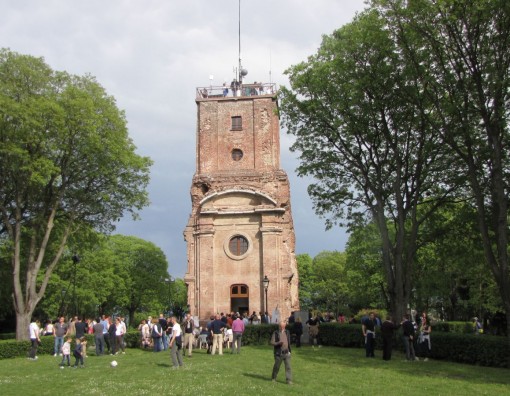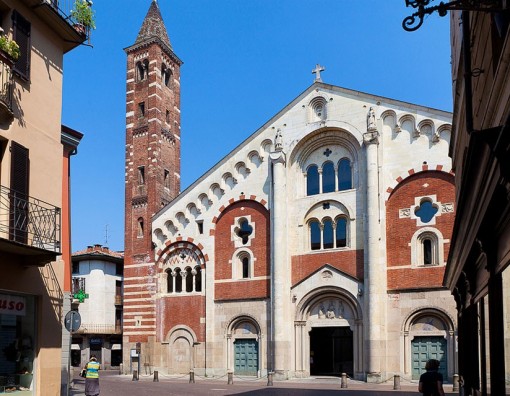
I'm going to tell you a story about Ovada, a town in Piedmont situated on the border between Piedmont and Liguria. We look forward to welcoming you and making your acquaintance among our enchanted landscapes and historic castles.
Ovada is a veritable chest of little treasures; don't expect to discover everything immediately. Travellers must be curious and ready to let themselves be thrilled. Do expect our courtesy; it may not be exuberant, but we do know how to give advice or suggestions.
When you arrive in the town you will be able to see (Piazza XX Settembre ), true hub of town traffic and connection point between the new neighbourhoods and the historic centre. Now, turn right, and you will be in our town centre.
On your left, is the Church of the Immaculate Conception, built as a votive offering by the Ovada people on 21 September 1631 to spare the town from the devastating plague epidemic.
The Church has been officiated for almost 350 years by the Franciscans, who have always been present in Ovada. Next to this structure is their convent and opposite it the piazza with a small fountain and the Statue of the Patron of Italy, all in a simple and sober setting, values that have always been pursued by the Order.
Continuing along the same road, you will find Via Cairoli. All our historic centre has a typical Genoese appearance; this is our imprint, given the relations and dominations for centuries.
This elegant and paved street is a real reference point for the residents of Ovada; it is the town's lounge, full of shops and business activities as well as historic palazzi of windows, of inhabited apartments; it is full of history and our business card.
Walking you will find several prestigious buildings, the Torrielli theatre placed right at the beginning of the street; a little further on, Palazzo Maineri, today seat of the principle cultural institutions of the town houses the Library and the Accademia Urbense, this building has had heterogeneous uses over the years; seat of the Town Hall, seat of the Professional Training School and also the German Command Headquarters, during the dark years of the war.
You are now in Piazza Assunta, you couldn't have gone wrong, the street is straight. You will find yourselves in front of the Parish Chuch N.S. Assunta a building which is almost 50 metres high. With two bell towers, one built in 1807 and the other in approximately 1850, it is the most important symbol of the town. Inside you will find marble furnishings and exquisite paintings and be able to fully understand our culture and our spiritual references.
You don't want to stop here do you? Good, then once you have gone out of the Parish church there is (Piazza Garibaldi ), dedicated to the Hero of the two worlds and to two of our fellow citizens who accompanied him in his adventure, dressed in a red shirt.
This square was once the seat of the social and political life of the town, the site of campaign rallies, which I would call fervent, and of gymnastics at the times of fascist Saturday, but also of the fraternity dinner with which the notable people of Ovada invited the people in 1848, putting themselves at their service even just for one day.
Let's head for Via San Paolo. Just a few more steps and you will be at the Oratory of the Annunziata, built in the 15th century and restored in the 18th century, an architectural gem rich in religious and artistic meanings. Two processional chests by Anton Maria Maragliano, a Genoese sculpture of absolute importance and prestige, are on display inside the church.
A little further on, we come to the Birthplace of San Paolo della Croce, Patron of the town and founder of the Passionist Congregation, declared a national monument in 1918, rich in mementos and relics of the Saint, and today seat of a Museum open to the public which we recommend you visit.
Opposite the house stands the Church of Santa Maria delle Grazie, called of San Domenico; during the Napoleonic Age it was used as barracks and warehouse.
The building underwent several renovations and was struck by some vicissitudes, such as a fire which destroyed the organ and blackened the plaster a few years ago.
Inside the building, fine artwork, paintings and sculptures in a sober and highly particular setting due to the presence of many bricks that adorn the Church.
Just a few more steps and we are at Palazzo Maineri-Rossi, from whose windows filter the unmistakable sounds of the students of the Rebora music school. With perseverance and commitment they try to learn the art of playing an instrument and carry on the musical tradition of our town.
We are about to end our tour which forms a square. Continuing along via Torino, we encounter Palazzo Delfino, which is now home to the Municipality, commissioned by a private person as seat of his bank and private home.
We are back in Piazza XX Settembre; the memorial monument, built with the collections of the families of Ovada is situated to the west of the Piazza.
Time for a rest, and in Via Carducci, you will find the beautiful (Park of Villa Gabrieli ) where you can rest and relax among the tree foliage and the lake of swans.
Don't think you have seen it all; this is just a small taste, there is still much more to discover and admire, such as the enchanting Loggia of San Sebastiano, the Oratory of San Giovanni which comes alive each year with the traditional procession and the Maini Palaeontology Museum that preserves local fossils and minerals.
In short, this is just the beginning of the story: come to Ovada and write your own, you will be satisfied and captivated by our beautiful landscapes.